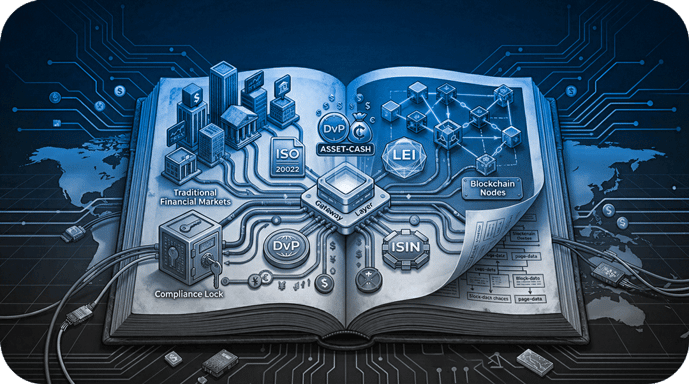
The latest move by DTCC, Euroclear and Clearstream shows that the future of digital assets will not be defined by who tokenizes first, but by who connects markets while preserving the same asset, the same rights and the same outcome.
Tokenization without interoperability is local efficiency, not a market, as we have discussed in several articles over the past few months. The next phase of digital assets will be defined by the ability to move assets with full equivalence between environments – technically, operationally and legally. It is this equivalence that turns technology into infrastructure.
A structural flaw
The market still treats tokenization as an issuance problem. This view is incomplete. Issuance solves the “birth” of the asset; it does not solve its life. The life of an asset – its trading, use as collateral, lifecycle events, custody, settlement and recognition in multiple jurisdictions – is what determines whether there is, in fact, a market.
What the recent move by the main global infrastructures makes clear is that the bottleneck is no longer in the creation of digital assets, but in their ability to circulate with operational integrity and legal validity across different environments: DLT and traditional infrastructures. Without this, each initiative remains local, even if technologically advanced.
The market’s mistake: interoperability is not “connecting blockchains”
Most discussions on interoperability got stuck at the level of technical connectivity: bridges, messaging, APIs and network compatibility. These mechanisms are necessary but insufficient.
The real problem is deeper: how to ensure that the asset that leaves one environment arrives in another as the same asset, with the same economic rights, the same ownership rules, the same lifecycle history and the same regulatory eligibility.
This involves at least:
-
Asset identity: standardization of attributes (LEI, vLEI, ISIN-like, metadata, classifications) that allow cross‑platform recognition in different jurisdictions, using global standards such as ISO 20022 in the design.
-
Lifecycle events: how corporate actions (interest, amortization, votes) are processed consistently across networks or even on‑chain; it is not uncommon to find initiatives labeled as “tokens” where almost nothing is executed on‑chain and most remains off‑chain, making blockchain just another layer of complexity.
-
Finality: when a transaction is irrevocable in one environment and recognized as such in another, on‑chain operations need effective validity correlated to the asset.
-
Enforcement: the ability to enforce contractual and regulatory rights outside the original ledger, or the ability for the asset holder to return to the original ledger to exercise those rights.
-
Without these guarantees, connecting networks only multiplies points of failure and creates state divergence – exactly the opposite of what financial markets require at institutional scale
Without standardization, there is no market
Interoperability at scale requires a minimum level of standardization in three layers that the paper clearly highlights, and that we have been addressing in several articles:
- Data (Data Standardization)
- Common models for representing assets (attributes, events, statuses following ISO norms).
- Aligned taxonomies (asset classes, risks, eligibility).
- Consistent identifiers that survive across multiple environments.
- Processes (Process Harmonization)
- Issuance, trading, settlement and corporate action flows with equivalent semantics
- DvP (delivery versus payment) rules and synchronization between asset and cash legs.
- Exception handling and dispute resolution preferably on‑chain.
- Roles (Roles Consistency)
- Clear definition of functions: issuer, custodian, CSD/ICSD, participant, paying agent.
- Responsibilities of each actor when crossing different environments.
- Access controls and segregation of duties (including multi‑tier custody models).
Without these three pillars, there is no way to guarantee the operational fungibility of the asset. And without fungibility, there is no market liquidity. By observing functions, processes and data, we can validate whether intermediaries are actually needed. The functions and processes are unquestionably necessary, but they may be executed largely by technology – something not deeply explored in the paper, as it is written by intermediaries, existing or new, but with more clearly defined and less centralized roles.
Convergence: where the thesis of the series materializes
When connecting the dots across the series, interoperability appears as the layer that enables – or blocks – all the others:
- Privacy and regulation: when moving an asset across environments, AML/CFT, KYC and data protection obligations must “travel with the asset”, not remain locked to the original ledger.
- Interoperability and confidentiality: consistency of rights requires that different participants see what is necessary – no more, no less – while maintaining auditable trails for supervisors, who do not need to delegate this to market agents, but can be the regulators themselves.
- Invisible infrastructure: value is not in the ledger, but in the ability to run complex processes with predictability.
- Digital money: without integration with the cash leg (fiat, RTGS or equivalents), there is no effective settlement; stablecoins, CBDCs and even connections with traditional settlement structures will determine institutional scale.
- Financial infrastructure: without interoperability, tokenization delivers local efficiency but does not create an integrated market; we will see a new group of “tokenizers” operating in silos, generating rework while promising cost reductions.
The end of the “single ledger”: the reality will be a network of networks
The hypothesis of a single dominant ledger does not hold in practice. What emerges is a network‑of‑networks model, where multiple infrastructures coexist and are connected by:
- Gateways that translate states and events between environments.
- Standards that guarantee semantic equivalence.
- Regulated services that ensure custody, settlement and compliance.
In this model, competitive advantage shifts. It is not about owning the ledger, but about operating the interconnection layer with reliable governance – including process orchestration, state synchronization and cross‑environment finality. Here, market‑wide projects outperform single‑firm initiatives and/or already dominant infrastructures, as presented in the article.
Where interoperability really matters (critical cases)
The usefulness of interoperability appears in the market’s most demanding use cases:
- Asset–cash settlement (DvP):
Synchronizing delivery of the asset on DLT with settlement in fiat (or equivalent) infrastructure without the risk of one leg settling without the other.
- Multi‑environment lifecycle:
Processing corporate actions (interest, dividends, credit events) when the asset is distributed across different networks and custodians.
- Collateral management:
moving, substituting and rehypothecating collateral across environments while maintaining eligibility, haircuts and consistent risk rules.
- Multi‑tier custody:
operating structures where different custody levels (global, local, sub‑custodian) interact with on‑chain and off‑chain records.
These are the points where markets gain or lose efficiency. And they are exactly where interoperability stops being a concept and becomes an operational requirement. In the context of Drex and later in LiftLab, we had the opportunity to test and challenge the concept of interoperability with the real world. While much of the discussion remained technical – around which type of ZK is “best” – we focused on extending interoperability across diverse and complex environments.
The new race: governing the infrastructure
The strategic shift is clear: from technology to governance. Those who can ensure that an asset:
- maintains its identity across networks,
- preserves economic and legal rights,
- meets regulatory requirements in multiple jurisdictions,
- settles with recognized finality,
will control the infrastructure that underpins the market. This includes defining standards, operating gateways, coordinating processes and integrating DLT with traditional infrastructures without recreating operational risk.
Understanding interoperability as governance – not just integration – is the necessary step to grasp how digital markets will truly scale.
[ Digital Asset Securities Interoperability Framework , https://www.dtcc.com/-/media/interoperable-digital-asset-securities-white-paper.pdf]

To learn more about BBChain, its products and services, visit: bbchain.com.br/en
Subscribe to Digital Currency Pulse - The bi-weekly pulse of digital currencies — CBDCs and Stablecoins in a global overview, with insider analysis. BBChain CEO's newsletter on LinkedIn.